During Advent we light four candles in preparation for Christ’s birth: joy, hope, love and peace.
Too often, we pretend that these four things have come to pass in our lives and in our world. Too often during Christmas, whether it is the time with family or the eggnog or the “good cheer,” we put on masks and pretend that all is well in the world. But as each candle was extinguished last night, I was reminded that there are those living without joy, hope, love and peace this Christmas.
Joy: The Holidays can often bring a cloud of depression into the lives of people. The dark haze makes one lose focus; makes one numb to the external world. “Joy to the World” is song without the realization that we are also to receive Joy. There are those without Joy this Christmas
Hope: The people of the Gulfport and New Orleans who are still without adequate shelter. There are thousands of people who have lost their homes and are forced to live in FEMA trailers or tents. A CNN interview spoke to a woman who said that this was not the Holiday season for her, or her family, because they could not

Sunday, December 25, 2005


Sunday, December 18, 2005
All I want for Christmas.
The greatest Christmas experience I have had was the last time Christmas was on a Sunday (1994). I had just begun attending church under my own volition. Like most high school guys, this was a the result of a "cute" girl who invited me to help serve the homeless breakfast on Sunday mornings at 6am. As the semester progressed, however, I decided to start serving and going to the youth group even if the girl was not there. When Christmas rolled around, I realized that the homeless breakfast would still be held though Sunday was also Christmas morning.
In the past (and subsequent Christmas mornings), I would wait patiently at the top of the stairs until the family was ready to see what Santa had brought me. This year, my mother, brother and I decided that we would go to the church and serve breakfast prior to even setting foot into the room with Christmas presents. At the breakfast, not only did we help serve food and hand out the stockings the church had gathered for the homeless, but we also worshipped alongside these men and women.
I do not remember what gifts I received that year, but I do remember handing out warm hats and gloves so others could survive the winter. I don't remember what I had for Christmas breakfast, but I do remember the hardboiled eggs and sausage we served. I remember the signing carols alongside a homeless man dressed in an awesome grey suit, as I doned a ratty apron. I remember meeting a woman whose Bible was as worn as her hands. I went to help others celebrate Christmas, but on that morning I realized I was the one in need of celebrating a true Christmas.
Seminary is doing strange things to me. Prior to PTS, I thought social justice was a nonessential to the Christian faith, an afterthought, or a sneaky way for "cute" girls to invite high school boys to church. In fact, I became so focused on evangelism, that I thought the message of Jesus Christ's personal salvation for you was being drowned out by the concerns of the oppressed, the poor, the others.
Recently however, I have realized and been reminded that Jesus's message of Grace is not only about an eschatological promise (seminary language for "heaven") but also about earthly promise against injustice. Therefore, I understand people's frustrations with those "Activist" Christians. But the more aware I am of others, and especially of my role in oppression, I realize that I have to respond.
 While I love the presents I have bought for my wife, my family and my friends, this morning I realized that this season gives us a chance to respond. All I want for Christmas is here.
In the past (and subsequent Christmas mornings), I would wait patiently at the top of the stairs until the family was ready to see what Santa had brought me. This year, my mother, brother and I decided that we would go to the church and serve breakfast prior to even setting foot into the room with Christmas presents. At the breakfast, not only did we help serve food and hand out the stockings the church had gathered for the homeless, but we also worshipped alongside these men and women.
I do not remember what gifts I received that year, but I do remember handing out warm hats and gloves so others could survive the winter. I don't remember what I had for Christmas breakfast, but I do remember the hardboiled eggs and sausage we served. I remember the signing carols alongside a homeless man dressed in an awesome grey suit, as I doned a ratty apron. I remember meeting a woman whose Bible was as worn as her hands. I went to help others celebrate Christmas, but on that morning I realized I was the one in need of celebrating a true Christmas.
Seminary is doing strange things to me. Prior to PTS, I thought social justice was a nonessential to the Christian faith, an afterthought, or a sneaky way for "cute" girls to invite high school boys to church. In fact, I became so focused on evangelism, that I thought the message of Jesus Christ's personal salvation for you was being drowned out by the concerns of the oppressed, the poor, the others.
Recently however, I have realized and been reminded that Jesus's message of Grace is not only about an eschatological promise (seminary language for "heaven") but also about earthly promise against injustice. Therefore, I understand people's frustrations with those "Activist" Christians. But the more aware I am of others, and especially of my role in oppression, I realize that I have to respond.
While I love the presents I have bought for my wife, my family and my friends, this morning I realized that this season gives us a chance to respond. All I want for Christmas is here.
Persons of The Year

It is exciting to see the Gateses and Bono receive recognition for their humanitarian effort--and they have not been very subtle about their work this past year. Obviously, this fuels my growing interest regarding the ONE campaign. And Time will receive my $1.50, or whatever they now charge, tomorrow when the issue hits the newsstand.
For being shrewd about doing good, for rewiring politics and re-engineering justice, for making mercy smarter and hope strategic and then daring the rest of us to follow, Bill and Melinda Gates and Bono are Time's Persons of the Year
Since, Time won't give it away for free, I'll try to post some sound bites from the issue. Here is Reuters article:
My concern is that "Persons of the Year" tends to suggest a completed project, or influence--such as the recent Whistle Blowers winner (2003). The same argument could be made about President Bush's influence after winning the Person of the Year in 2004: his political clout and approval rating have dropped dramatically. This decrease of influence, however, is inevitable because, like the SI Cover Story curse, once one makes it to the pinnacle of their career and achieves coverstatus their influence will obviously diminish.
Though Debt relief of $50 Billion was achieved this summer, this is the beginning of the end of desperate poverty (to paraphrase Bono) not the end itself. Therefore, remain aware of the global situation, and not just think that the wealthy Bono and Gateses have achieved the necessary reforms.
Saturday, December 17, 2005
series: simpsons' dialogue
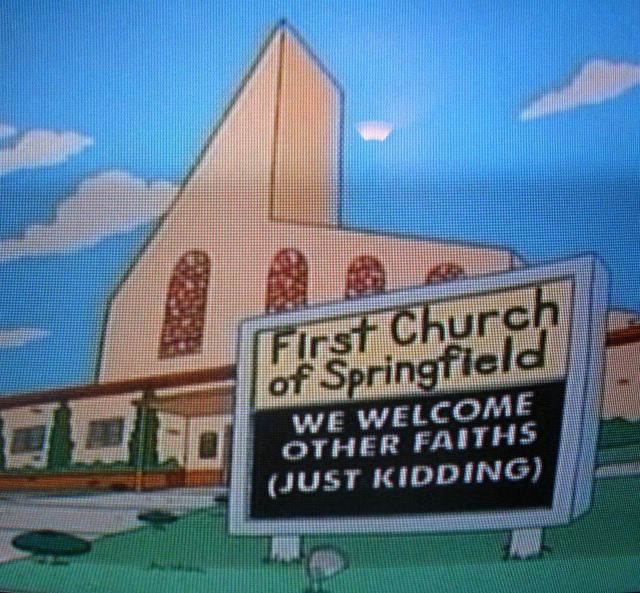
dialogue does not patronize others...so don't pretend to be open to dialogue if you are not. Otherwise, people will catch onto you pretty quickly.
Not saying you have to be open for interfaith dialogue, but if you are, do it with Godly respect.
If you don't respect others, you become the butt of a Simpsons' joke and quickly dismissed.
Thursday, December 15, 2005


trade freedom?
"Most people in Hong Kong don't understand what they (the protesters) are doing," said K.K. Cheung, a retired construction engineer. "This is not in their culture. They like free trade."
That reveals the point that most Wealthy nationalist fail to realize, these protests are because the current situation may look like "free trade," but it provides little structure for Freedom. Yes, tariff-free cotton from Africa imported into the United States is "free," but it is not liberating.
Here are some interesting quotes from a Reuters article:
Rich nations wrangle, poor complain at trade talks
"In the three days the meetings have taken so far, the rich countries have transferred more than $2 billion to their farmers in various forms of support," World Bank Vice President Danny Leipziger said in a statement.
"In the same period, the 300 million poorest people in Africa have earned less than $1 billion between them."
The United States also came under fire over the $4 billion a year in subsidies enjoyed by its cotton farmers, and won little respite when it announced its willingness to offer duty-free access for cotton from impoverished West African states.
But the United States has been reluctant to allow poor exporters free access to sensitive areas such as textiles, sugar and cotton, and Japan does not want to open up its rice market.
That reveals the point that most Wealthy nationalist fail to realize, these protests are because the current situation may look like "free trade," but it provides little structure for Freedom. Yes, tariff-free cotton from Africa imported into the United States is "free," but it is not liberating.
Here are some interesting quotes from a Reuters article:
"In the same period, the 300 million poorest people in Africa have earned less than $1 billion between them."
Tuesday, December 13, 2005
series: what is verbal dialogue?
Probably 98.4% of the time when we discuss "dialogue" we think about verbal dialogue. Therefore, I think that this question is rather self explanatory, and a time to reiterate the important criteria about dialogue:
It takes more than one person, it has no agenda, it is circular (a time of speaking-listening-responding-listening-responding...), it is mutually edifying.
"Verbal" dialogue is the attempt to expand one's perspective through audiable language.
When I led a mission trip to the Dominican Republic, I had an interest encounter with untypical verbal dialogue.
We were working in the city of Santa Domingo for a local Young Life Club. One Tuesday night, we participated in the neigborhood's Young Life Club. [For those who are not familiar with Young Life, Club is the hour long "program" that consists of games, music and someone sharing the gospel.] I had taken Spanish all through high school, but this trip reminded that my spanish, especially religious spanish was near non-existent.
However, I was amazed that I could "understand" the Young Life leader's Gospel presentation, because I have stood before a crowd of students many times to convey the same message. My understanding was not a result of hearing the words, but in the shared experience both of us have had in leading "clubs." After the talk, I was able to have a typical verbal dialogue with the leader through a translator, and both of us expanded our understandings of sharing the Gospel to youth.
I was challenged to see my experience of privelege and fortune and how that may distort my understanding of the gospel; what he learned I do not know.
That is the challenge of Dialogue, I often leave conversations with friends and later wonder if I was listened to. I know that I am often transformed by our verbal discussions, and I can only hope that they too may have been transformed by our discussion to create a circular dialogue.
It takes more than one person, it has no agenda, it is circular (a time of speaking-listening-responding-listening-responding...), it is mutually edifying.
"Verbal" dialogue is the attempt to expand one's perspective through audiable language.
When I led a mission trip to the Dominican Republic, I had an interest encounter with untypical verbal dialogue.
We were working in the city of Santa Domingo for a local Young Life Club. One Tuesday night, we participated in the neigborhood's Young Life Club. [For those who are not familiar with Young Life, Club is the hour long "program" that consists of games, music and someone sharing the gospel.] I had taken Spanish all through high school, but this trip reminded that my spanish, especially religious spanish was near non-existent.
However, I was amazed that I could "understand" the Young Life leader's Gospel presentation, because I have stood before a crowd of students many times to convey the same message. My understanding was not a result of hearing the words, but in the shared experience both of us have had in leading "clubs." After the talk, I was able to have a typical verbal dialogue with the leader through a translator, and both of us expanded our understandings of sharing the Gospel to youth.
I was challenged to see my experience of privelege and fortune and how that may distort my understanding of the gospel; what he learned I do not know.
That is the challenge of Dialogue, I often leave conversations with friends and later wonder if I was listened to. I know that I am often transformed by our verbal discussions, and I can only hope that they too may have been transformed by our discussion to create a circular dialogue.
Sunday, December 11, 2005
Christ being manipulated by culture
I am all about the Church engaging culture, or as Neihbur labels it, Christ transforming culture. However, this article in the Philadelphia Inquirer is very bothersome:
From Dec. 4th, 2005 Philadelphia Inquirer

Attention, pastors: You have just four weeks remaining to work a lion, a witch or a wardrobe into your next sermon. Walt Disney Pictures is so eager for churches to turn out audiences for The Chronicles of Narnia: The Lion, the Witch and the Wardrobe, which opens Friday, that it's offering a free trip to London - and $1,000 cash - to the winner of its big promotional sermon contest. The only catch is that the sermons must mention Narnia, based on the hugely popular Passion of the Christ.
So next time your minister mentions Narnia in her sermon, you can see if she has soldout to Disney.
From Dec. 4th, 2005 Philadelphia Inquirer
Hyping 'Narnia' to Christians
Attention, pastors: You have just four weeks remaining to work a lion, a witch or a wardrobe into your next sermon. Walt Disney Pictures is so eager for churches to turn out audiences for The Chronicles of Narnia: The Lion, the Witch and the Wardrobe, which opens Friday, that it's offering a free trip to London - and $1,000 cash - to the winner of its big promotional sermon contest. The only catch is that the sermons must mention Narnia, based on the hugely popular Passion of the Christ.
So next time your minister mentions Narnia in her sermon, you can see if she has soldout to Disney.
Friday, December 09, 2005
a cause: ONE.org
and we have the resources to help
ONE.org is the Make Povery History Campaign for the United States of America.
 One is in reference to a request that the US reallocate its budget by 1% to help those desperately in need.
By directing an additional ONE percent of the U.S. budget toward providing the most basic needs - and fighting the corruption that wastes precious resources -- we can help transform the futures and hopes of an entire generation in the poorest countries.
With an additional ONE percent of our budget:We can help prevent 10 million children from becoming AIDS orphans We can help get 104 million children into grade school. We can help provide water to almost 900 million people around the globe. We can save almost 6.5 million children under 5 from dying of diseases that could be prevented with low-cost measures like vaccination or a well for clean water. We can build a better, safer world for all.
30 million girls in sub-Saharan Africa dont have access to schools. Getting girls into school is one of the best ways to improve their futures, their health and the health of their families.
ONE percent of the U.S. budget is $25 billion, and redirecting that much money would have to be done over time. Directed to honest governments, private charities and faith-based organizations, this support would provide the tools and resources they need to really make a difference. American support would be part of a compact with poor countries who fight corruption and use their own resources to help their people out of poverty. American leadership would be an example for rich countries in Europe and Asia to do their share to help the poorest people in the world.
Way too many for our neighbors to be suffering under.
Please check out the ONE.org campaign for more information--this is something that has been flying under the radar screen for far too long. And I pray that God would transform our hearts to see beyond our lives, our neighborhoods and our country to see a tragic global problem.
Just one example:
The Story of Lesotho

now it is facing a triple crisis: sharply reduced demand for its labour, as the mines become exhausted; a rising tide of HIV and Aids, and declining agriculture as erosion and drought reduces its crop yields.

Thursday, December 08, 2005
God loves the bald
 From there Elisha went up to Bethel. As he was walking along the road, some youths came out of the town and jeered at him. "Go on up, you baldhead!" they said. "Go on up, you baldhead!" He turned around, looked at them and called down a curse on them in the name of the LORD. Then two bears came out of the woods and mauled forty-two of the youths. And he went on to Mount Carmel and from there returned to Samaria.
Wednesday, December 07, 2005
...purpose driven art
Genesis 1:28


What is the point of creation?
To imitate or innovate?
If it is to produce a product than why not simply regurgitate what is already labeled a masterpiece?
For me creation is the contemplation, execution and intrepretation of artmaking, that is why a blank canvas is exciting and intimidating simultaneously. Intimidating because it will change me...exciting because it will change me.
Tuesday, December 06, 2005
series: what is not "dialogue?"
It always seem easier to define what something is by describing what is not.
Dialogue is not a one-way conversation
Therefore, Dialogue does not place one person as the central speaker who contains the accurate information that needs to be conveyed to the hearers. In the church that has often led to the abuse of the pulpit. A good whole book devoted to this issue is "Preaching Re-imagined"by Doug Pagitt, the pastor of Solomon's Porch.
Dialogue is not a debate
Often times that is the format discussions take because we are trying to convince the hearers that the person/concept we are confronting is wrong. In doing so we are establishing ourselves and our perspective as right. This attempt to be corrective however is not dialogue because it undercuts mutual growth. Instead it insists that your opponent either change their perspective or lose the debate.
Unfortunately this is the form that Modern Academic education applauds. We are taught to read texts, listen to lectures and find someway to discredit the other person. Thereby allowing our perspective to become more credable.
In debating we are taking the weakest points of our opponent and using our strongest convictions to "prove them wrong." When we provide an incomplete or weak point we get frustrated because we are being taken to "literally," and feel that our underlying point is not being heard because of surface weaknesses. But we fail to provide that charity to our opponent.
Dialogue is not hearing
Often times we think we are hearing our opponent, but what we are hearing is the surface material. Take for example interfaith dialogue. I believe that at most churches and even in PTS, other faiths are taught in a manner to strengthen our own notions of Christianity. We attend these meetings, seminars, encounter people of other faiths to hear but not to listen. By listening we are beginning to embody the other's position and see the fullness and the richness.
Let me give you an example. In college I took an Intro course to Hindu, I do not now recall the specific sect of Hindi, but we read their creation story. In it was a beautiful story about a god whose body was torn apart to create the earth, the stars and all of creation. While we could giggle at their concept of a god that looks at elephant, or that their creation myth isobviously a farse, we would not listen to the deeper message and not enrichen our perspective of life.
Dialogue is not purpose-driven.
If there is a point, an agenda, a claim that drives the communication to reach then it is not really a dialogue but propganda. If someone knows where this is leading and is forcing it to arrive at that conclusion then (s)he is failing to allow for a fluid conversational dialogue. Rather, dialogue is like sitting around the bar having a few beers and shooting the breeze, at a deeper level. It is being able to see how this other person is redefining your understanding of yourself, the world and of God.
Therefore, Dialogue does not place one person as the central speaker who contains the accurate information that needs to be conveyed to the hearers. In the church that has often led to the abuse of the pulpit. A good whole book devoted to this issue is "Preaching Re-imagined"by Doug Pagitt, the pastor of Solomon's Porch.
Often times that is the format discussions take because we are trying to convince the hearers that the person/concept we are confronting is wrong. In doing so we are establishing ourselves and our perspective as right. This attempt to be corrective however is not dialogue because it undercuts mutual growth. Instead it insists that your opponent either change their perspective or lose the debate.
Unfortunately this is the form that Modern Academic education applauds. We are taught to read texts, listen to lectures and find someway to discredit the other person. Thereby allowing our perspective to become more credable.
In debating we are taking the weakest points of our opponent and using our strongest convictions to "prove them wrong." When we provide an incomplete or weak point we get frustrated because we are being taken to "literally," and feel that our underlying point is not being heard because of surface weaknesses. But we fail to provide that charity to our opponent.
Often times we think we are hearing our opponent, but what we are hearing is the surface material. Take for example interfaith dialogue. I believe that at most churches and even in PTS, other faiths are taught in a manner to strengthen our own notions of Christianity. We attend these meetings, seminars, encounter people of other faiths to hear but not to listen. By listening we are beginning to embody the other's position and see the fullness and the richness.
Let me give you an example. In college I took an Intro course to Hindu, I do not now recall the specific sect of Hindi, but we read their creation story. In it was a beautiful story about a god whose body was torn apart to create the earth, the stars and all of creation. While we could giggle at their concept of a god that looks at elephant, or that their creation myth is
If there is a point, an agenda, a claim that drives the communication to reach then it is not really a dialogue but propganda. If someone knows where this is leading and is forcing it to arrive at that conclusion then (s)he is failing to allow for a fluid conversational dialogue. Rather, dialogue is like sitting around the bar having a few beers and shooting the breeze, at a deeper level. It is being able to see how this other person is redefining your understanding of yourself, the world and of God.
Monday, December 05, 2005
i'm that guy...
 Yesterday as I drove to my field education site, I realized that I was that southern guy trying to drive in snow. We merely had gotten a few inches, but since this is my first winter in New Jersey with a car, I know remember that I hate driving in the snow.
I hurdled myself down the freeway at 50 mph, but was being glared at by the passing SUVs. You see down south the concern is not snow but ice--so what I do not get is when the temperature is under 32 degrees how the puddles are not sheets of ice.
Anyway, I figured I might as well prosper on my ineptitude and fund a new warning sign that the DMV gives out to all of us transplants.
PS for those who only have blizzards and snowstorms and have not seen what an "Ice Storm" is.
Friday, December 02, 2005
series: what do I mean by "dialogue?"
Here is what Merriam-Webster says:
Dialogue
1: a written composition in which two
or more characters are represented as conversing
2a: a conversation between two or more persons; also a similar exchange between
a person and something else (as a computer)
b: an exchange of ideas and opinions
c: a discussion between representatives
of parties to a conflict that is aimed
at resolution
4: a musical composition for two or
more parts suggestive of a conversation.
While this is an adequate description of “dialogue” I want to highlight a few things that I think are essential to recognize about dialogue.
it involves more than one person
it involves an exchange of ideas
it is listening (not hearing) and speaking
while it is “aimed at a resolution” it will never achieve a resolution, because a dialogue should build upon itself
I think the M-W’s 4th definition is a great way to think of dialogue because music and art is concerned with the process of composition and not about the final project. That is why U2, Phish, Elvis, Mozart, etc. repeatedly played their musical compositions. Each time, in each setting, a new “voice” was added to their dialogue.
wb:Dialogue is the process of creating a form of communication that relies upon more than one person with a variety of perspectives, which leads towards a richer understanding of each other and oneself.
1: a written composition in which two
or more characters are represented as conversing
2a: a conversation between two or more persons; also a similar exchange between
a person and something else (as a computer)
b: an exchange of ideas and opinions
c: a discussion between representatives
of parties to a conflict that is aimed
at resolution
4: a musical composition for two or
more parts suggestive of a conversation.
While this is an adequate description of “dialogue” I want to highlight a few things that I think are essential to recognize about dialogue.
I think the M-W’s 4th definition is a great way to think of dialogue because music and art is concerned with the process of composition and not about the final project. That is why U2, Phish, Elvis, Mozart, etc. repeatedly played their musical compositions. Each time, in each setting, a new “voice” was added to their dialogue.
wb:Dialogue is the process of creating a form of communication that relies upon more than one person with a variety of perspectives, which leads towards a richer understanding of each other and oneself.
series: theology of "dialogue"
After a great conversation with a friend, I was challenged as to why I find “dialogue” so important in the practice of the church. So I have come up with a list of questions that I think we help me discover how “dialogue” informs my theological perspective.
Join me on the journey the next few weeks, unless it turns out to be like the poker table project that took months to complete, as I wrestle with a “Theology of Dialogue.”
Below are the questions I have begun to assemble—they will probably change over the course of journaling. I promise I will be concise in my answers...Please provide feedback, correction, clarification and more questions as I journey."
| What do I mean by “dialogue?" | What is not dialogue? |
| What is verbal dialogue? | What is nonverbal dialogue? |
| What is risked? | What is gained? |
| How is it Trinitarian? | |
| How is it Incarnational? | How is it Pneumatological? |
| How is it scriptural? | How is it sacramental? |
| How is it reformed? | |
| How does it respect tradition? | How is it culturally engaged? |
| How does it impact ministry? | How does it impact worship? |
| How does it influence God’s relationship to us? | How does it develop our relationship to the world? |
| How does it foster community? | How does it foster ecumenism? |
| Who are some real theologians that have a richer, better explained perspective of “dialogue”? | ? |
Thursday, December 01, 2005
Football Trivia

Team 1
Hint: Dungy justed suggested that he may not even get the chance to beat this team this season.
Hint: Dungy justed suggested that he may not even get the chance to beat this team this season.
Team 2
Hint: Team 2, he lost to his final game of his rookie
season and a second time when Team 2 was undefeated.
Subscribe to:
Posts (Atom)